
 我的书签
 添加书签
 移除书签
应用开发:Workflow / Chatflow(2/2)
        yield self.finish_log_message(
            log=model_log,
            data={
                "output": response,
                "tool_name": tool_call_names,
                "tool_input": tool_call_inputs,
            },
            metadata={
                "started_at": model_started_at,
                "finished_at": time.perf_counter(),
                "elapsed_time": time.perf_counter() - model_started_at,
                "provider": params.model.provider,
            },
        )
        yield self.create_text_message(
            text=f"{response or json.dumps(tool_calls, ensure_ascii=False)}\n"
        )
        result = ""
        for tool_call_id, tool_call_name, tool_call_args in tool_calls:
            tool_instance = tool_instances[tool_call_name]
            tool_invoke_responses = self.session.tool.invoke(
                provider_type=ToolProviderType.BUILT_IN,
                provider=tool_instance.identity.provider,
                tool_name=tool_instance.identity.name,
                parameters={**tool_instance.runtime_parameters, **tool_call_args},
            )
            if not tool_instance:
                tool_invoke_responses = {
                    "tool_call_id": tool_call_id,
                    "tool_call_name": tool_call_name,
                    "tool_response": f"there is not a tool named {tool_call_name}",
                }
            else:
                # invoke tool
                tool_invoke_responses = self.session.tool.invoke(
                    provider_type=ToolProviderType.BUILT_IN,
                    provider=tool_instance.identity.provider,
                    tool_name=tool_instance.identity.name,
                    parameters={**tool_instance.runtime_parameters, **tool_call_args},
                )
                result = ""
                for tool_invoke_response in tool_invoke_responses:
                    if tool_invoke_response.type == ToolInvokeMessage.MessageType.TEXT:
                        result += cast(
                            ToolInvokeMessage.TextMessage, tool_invoke_response.message
                        ).text
                    elif (
                        tool_invoke_response.type == ToolInvokeMessage.MessageType.LINK
                    ):
                        result += (
                            f"result link: {cast(ToolInvokeMessage.TextMessage, tool_invoke_response.message).text}."
                            + " please tell user to check it."
                        )
                    elif tool_invoke_response.type in {
                        ToolInvokeMessage.MessageType.IMAGE_LINK,
                        ToolInvokeMessage.MessageType.IMAGE,
                    }:
                        result += (
                            "image has been created and sent to user already, "
                            + "you do not need to create it, just tell the user to check it now."
                        )
                    elif (
                        tool_invoke_response.type == ToolInvokeMessage.MessageType.JSON
                    ):
                        text = json.dumps(
                            cast(
                                ToolInvokeMessage.JsonMessage,
                                tool_invoke_response.message,
                            ).json_object,
                            ensure_ascii=False,
                        )
                        result += f"tool response: {text}."
                    else:
                        result += f"tool response: {tool_invoke_response.message!r}."

                tool_response = {
                    "tool_call_id": tool_call_id,
                    "tool_call_name": tool_call_name,
                    "tool_response": result,
                }
        yield self.create_text_message(result)

    def _convert_tool_to_prompt_message_tool(
        self, tool: ToolEntity
    ) -> PromptMessageTool:
        """
        convert tool to prompt message tool
        """
        message_tool = PromptMessageTool(
            name=tool.identity.name,
            description=tool.description.llm if tool.description else "",
            parameters={
                "type": "object",
                "properties": {},
                "required": [],
            },
        )

        parameters = tool.parameters
        for parameter in parameters:
            if parameter.form != ToolParameter.ToolParameterForm.LLM:
                continue

            parameter_type = parameter.type
            if parameter.type in {
                ToolParameter.ToolParameterType.FILE,
                ToolParameter.ToolParameterType.FILES,
            }:
                continue
            enum = []
            if parameter.type == ToolParameter.ToolParameterType.SELECT:
                enum = (
                    [option.value for option in parameter.options]
                    if parameter.options
                    else []
                )

            message_tool.parameters["properties"][parameter.name] = {
                "type": parameter_type,
                "description": parameter.llm_description or "",
            }

            if len(enum) > 0:
                message_tool.parameters["properties"][parameter.name]["enum"] = enum

            if parameter.required:
                message_tool.parameters["required"].append(parameter.name)

        return message_tool

    def check_tool_calls(self, llm_result_chunk: LLMResultChunk) -> bool:
        """
        Check if there is any tool call in llm result chunk
        """
        return bool(llm_result_chunk.delta.message.tool_calls)

    def extract_tool_calls(
        self, llm_result_chunk: LLMResultChunk
    ) -> list[tuple[str, str, dict[str, Any]]]:
        """
        Extract tool calls from llm result chunk

        Returns:
            List[Tuple[str, str, Dict[str, Any]]]: [(tool_call_id, tool_call_name, tool_call_args)]
        """
        tool_calls = []
        for prompt_message in llm_result_chunk.delta.message.tool_calls:
            args = {}
            if prompt_message.function.arguments != "":
                args = json.loads(prompt_message.function.arguments)

            tool_calls.append(
                (
                    prompt_message.id,
                    prompt_message.function.name,
                    args,
                )
            )

        return tool_calls
#### 6. Debug the Plugin
With the declaration file and implementation code complete, verify that the plugin runs correctly. Dify supports remote debugging: go to **Plugin Management** to obtain your debug key and remote server address.
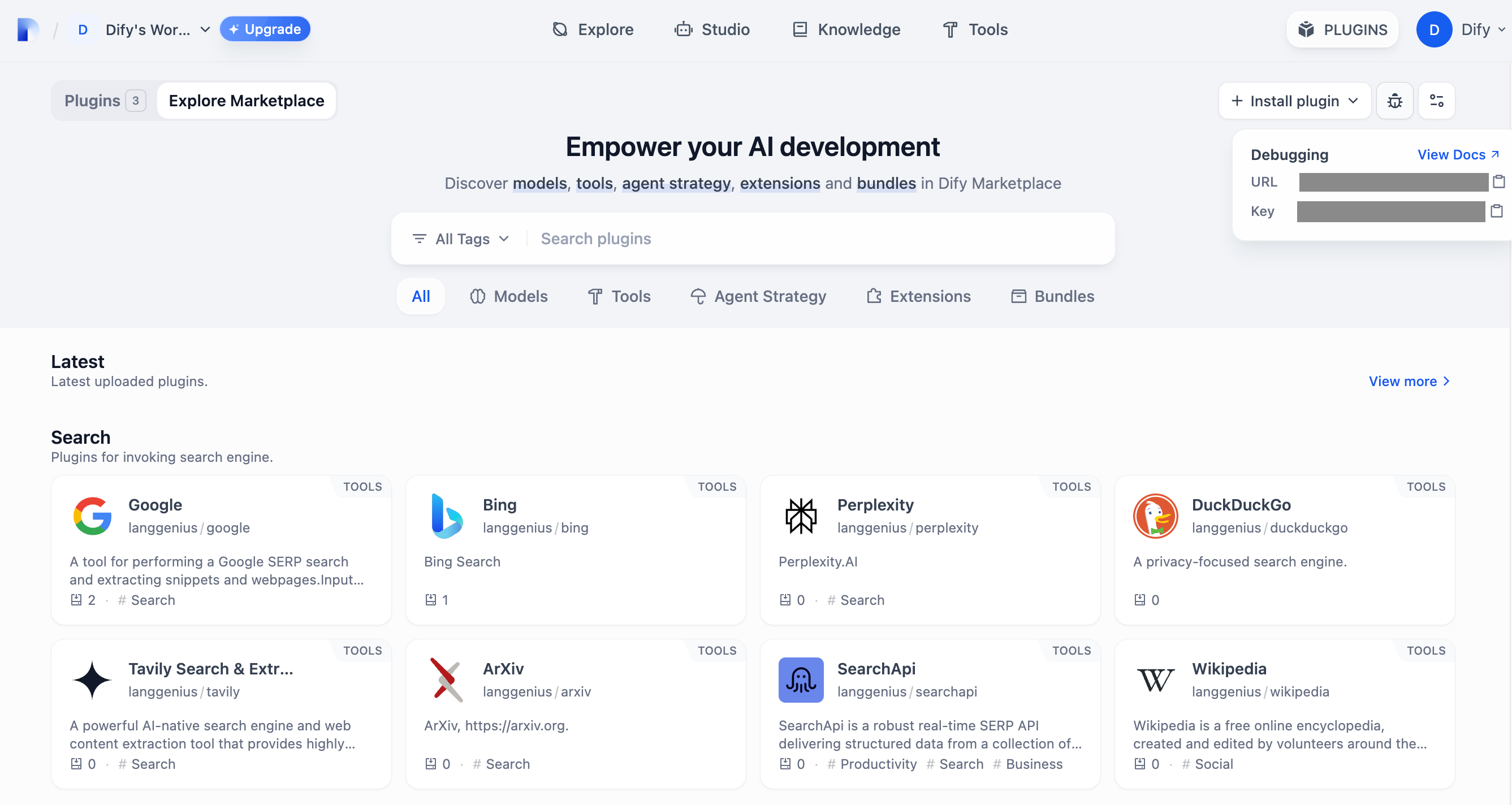
In your plugin project, copy `.env.example` to `.env` and fill in the remote server address and debug key.
```bash
INSTALL_METHOD=remote
REMOTE_INSTALL_URL=debug.dify.ai:5003
REMOTE_INSTALL_KEY=********-****-****-****-************
Then run:
python -m main
The plugin appears in your workspace, where team members can also access it.

Package the Plugin (Optional)
Once everything works, package your plugin by running:
# Replace ./basic_agent/ with your actual plugin project path.

dify plugin package ./basic_agent/
A file named basic_agent.difypkg (matching your plugin name) appears in your current folder. This is your final plugin package.
Congratulations! You've developed, tested, and packaged your Agent Strategy Plugin.
Publish the Plugin (Optional)
You can now submit the package to the Dify Plugins repository. Before doing so, ensure it meets the Marketplace preparation and validation requirements. Once approved, the package merges into the main branch and is released through the Marketplace pipeline.
Further Exploration
Complex tasks often need multiple rounds of thinking and tool calls, repeating the model invoke → tool use cycle until the task ends or the iteration limit is reached. Managing prompts well is crucial in this process. See the complete Function Calling implementation for a standardized approach to letting models call external tools and handle their outputs.

