我的书签
 添加书签
 移除书签
Is Your PPC Strategy Sabotaging Your SEO? 2.3M Keyword Study
Marketing reports, apps, and automations, handled. Meet Letaido.
Marketing reports, apps, and automations, handled. Meet Letaido.
The only AI marketing platform built on Ahrefs’ proprietary web index.
The only AI marketing platform built on Ahrefs’ proprietary web index.
“The AI marketing platform we needed didn’t exist. So we built it.”

Tim Soulo, CMO at Ahrefs
“The AI marketing platform we needed didn’t exist. So we built it.”
Tim Soulo, CMO at Ahrefs
SEO & Marketing Educator at Ahrefs
Contributors
Reviewed by
Updated: January 30, 20254 min read
56 Linking websitesArticle performance data from Ahrefs
Contents
- Advertising when you don’t have competitors: inefficient or intentional?
- A closer look: branded vs. non-branded keywords
- What the industry thinks
- How to check your site for PPC and SEO cannibalization
We analyzed ~2.3 million keywords with ~4.99 million top ads to see how frequently businesses advertise on keywords where they already have an organic ranking in the top 10 positions.
Here are some of the key statistics:
37.9% of advertised websites already rank in the top 10 organically for the same keyword. This indicates that a significant portion of businesses are paying for ads when they already have visibility for that term.
When looking at specific pages rather than entire websites, 15.7% of advertised URLs have an organic ranking in the top 10. This shows that, even at the page level, ads are often run on already high-ranking content.
Shockingly, 40.66% of pages that are advertised rank #1 organically. Essentially, these businesses are paying for the top ad placement on Google when they already rank in the number one organic position.
Contents
- Advertising when you don’t have competitors: inefficient or intentional?
- A closer look: branded vs. non-branded keywords
- What the industry thinks
- How to check your site for PPC and SEO cannibalization
Another surprising insight from our research is that in 51.09% of cases, businesses advertise a page that ranks in the top 10, even when there are no competing ads present.
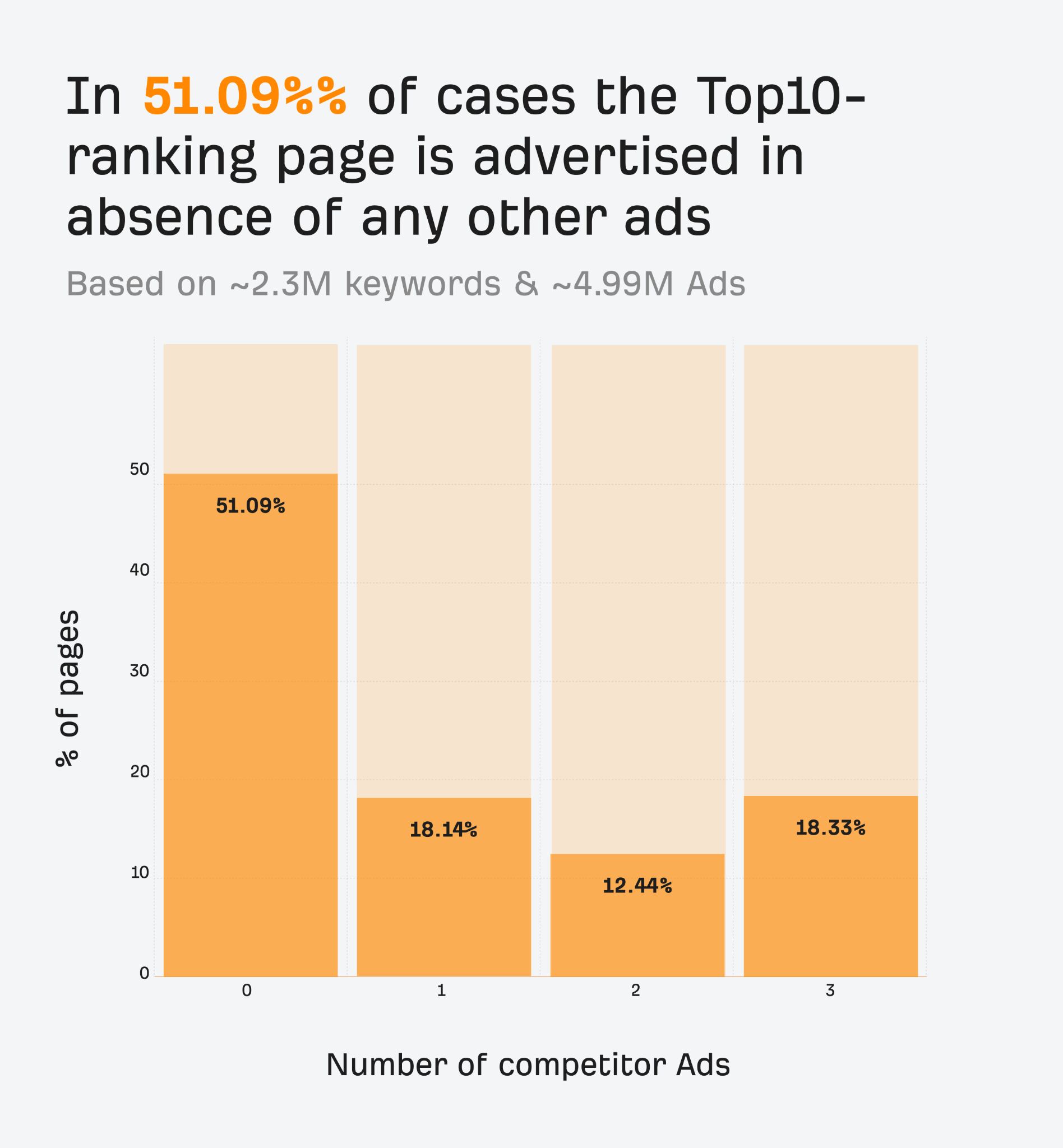
This suggests that many businesses might be running ads needlessly, generating costs without competing against other advertisers.
It's surprising, but brands often bid on their own branded keywords, even though they hold the top spot for those terms over half of the time.
This is totally different from how they do with non-branded keywords, where they're in first place about 25% of the time.
You'd think competition for non-branded keywords would be a bigger worry, but here's the twist: two-thirds of the time, brands bid on their branded keywords even when competitors aren't running ads.
If this strategy is intentional, I think this shows that brands are all about protecting their brand and making sure they're seen whenever someone searches for their name. Competition may be more dense on the non-branded terms, but they are probably more dangerous on branded terms.
This overlap between paid and organic raises two important questions.
Are businesses simply trying to dominate the SERPs, or is this a sign of a lack of coordination between SEO and PPC teams?
And perhaps more importantly, does running ads on keywords where you already rank well organically drive significantly more clicks, or is it just inflating your cost per acquisition?
We found answers to these questions and a few others among the comments received on LinkedIn (here and here). Here’s our attempt to summarize the discussion:
- Use PPC selectively: PPC campaigns should only complement organic rankings for highly competitive keywords or those pushed below the fold by ads. Avoid redundant spending where organic visibility is already strong.
- Measure impact on revenue, not vanity metrics: move beyond clicks and CTR. The true measure of success is incremental revenue.
- Rethink PPC for branded keywords: Some people claimed that PPC for branded terms often adds little value if you already rank well organically. Shift that budget to something else unless facing direct competition.
- Eliminate siloed strategies: PPC and SEO should work together, not against each other. For example, you can use PPC to test different types of content on the keyword you already rank (thanks for the idea, Olli!), or use it to rank for volatile keywords (like HubSpot does).
In one of the comments Nikolas Garfinkel shared research done in a similar field. Blake, Nosko, and Tadelis conducted a series of large-scale experiments to evaluate the impact of paid search advertising for both branded and non-branded keywords at eBay in 2014.
Their conclusion was that for established brands, running ads on brand terms was largely redundant. The results for non-branded keywords were similar: most clicks attributed to ads would have occurred organically anyway, meaning the return on investment (ROI) from these ads was negative. This aligns with our findings that businesses often compete against themselves by paying for clicks they could have received for free through strong organic rankings.
A big thank you to everyone who contributed with their comments!
If you want to run similar research on your site, you can use our Site Explorer (fun fact: we developed this feature as a result of the study). Enter your domain, go to the Paid keywords report and look at the Organic position column. You can also use the Organic position filter to show keywords in certain positions (for example, only the top 3).
Final thoughts
Marketers need to evaluate their PPC and SEO strategies in tandem. Are you truly adding value by running an ad for a keyword where you already have a presence, or could those ad dollars be better used elsewhere? Maybe it’s time to sit down with both the PPC and SEO teams and revisit your overlapping efforts.
Got questions or comments? Share them in this thread or let Tim (the author of the study) or me know. Big thanks to our data scientist Xibeijia Guan for running the analyses!
Post byMateusz Makosiewicz
Mateusz Makosiewicz is a marketing researcher and educator at Ahrefs. He has been involved in marketing for over 15 years, specializing in growth marketing, content marketing, marketing strategy, and management.
Mateusz studied Advertising and Media Marketing at the University of Gdańsk. He gained his marketing experience in agencies, SaaS companies, and hardware companies where he worked in various roles, from managing advertising projects for clients to leading marketing departments.
On Ahrefs blog he writes about SEO and marketing based on experience drawn from testing probably every piece of marketing advice ever published, trial and error in startup marketing in the Silicon Valley, and tweaking growth engines like his life depended on it.
Contributors
Reviewed by
Keep learning
[
Despina Gavoyannis](https://ahrefs.com/blog/author/despina-gavoyannis/)May 14, 2025
### Top 50 Fastest-Growing EdTech Companies
[
Si Quan Ong](https://ahrefs.com/blog/author/si-quan-ong/)July 3, 2026
### Top Google Searches (September 2026)
[
Ryan Law](https://ahrefs.com/blog/author/ryan-law/)March 3, 2026
### Wikipedia vs Grokipedia: 5x the Pages, 70x the Citations, 1615x the Traffic
[
Nick Churick](https://ahrefs.com/blog/author/nick-churick/)May 23, 2017
### Can You Get Good Traffic From Pinterest to Your Blog in a Short Run? [Case Study]
[
Tim Soulo](https://ahrefs.com/blog/author/tim-soulo/)May 29, 2017
### Ahrefs’ Study Of 2 Million Featured Snippets: 10 Important Takeaways
Your weekly marketing’s must-reads
Join 284K marketers for weekly news, useful reads, industry updates, and the memes you didn’t know you needed.
Explore what’s inside the newsletter →
Blog
A beginner’s guide to SEO basics, with resources to help you start ranking higher.
Product
© 2026 Ahrefs Pte. Ltd. (201227417H) 16 Raffles Quay, #33-03 Hong Leong Building, Singapore 048581
Cookie Settings
English